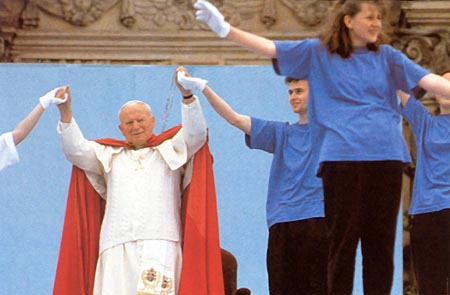
 eradicate the discussion on dance in worship, which have unfortunately experienced by the ongoing liturgical abuses in the pontificate of John Paul II's constant buoyancy. 1975 was the Roman Congregation for Divine Worship and the Discipline of the Sacraments a document entitled "Liturgical Dance", in which she clarified:
 dance can be made in any form an integral part of liturgical celebrations. For a very unholy and sacrilegious element would be introduced into the liturgy, and that would create a secular atmosphere for all participants and attendees to worldly places and situations should remember.In 1998 the same congregation to the Bishop of Honolulu to ban hula dances in liturgical contexts, which were in Hawaii long ago entered the liturgy. But when John Paul beatified 1995 by Father Damien DeVeuster, the famous saint of the lepers of Hawaii, traveled to Brussels, was performed at a central point of the ceremony, a hula dance.
 In 2002, John Paul II was in Mexico for the beatification of two martyrs of the Mayan people. On that occasion the papal Zeremoniar Archbishop Piero Marini various dances integrated into the liturgy. At the end was a sort of cleansing ceremony called "Limpia" performed by the dancers who appeared with incense bowls and the Pope and other cardinals and bishops present sprinkled with herbs. This ritual is used to cure physical and mental illness by driving out evil spirits. In fact, the Pope was exorcised so before the eyes of the public in a pagan ritual. Understandably, there was behind sharp protest from both Mexico and the Vatican circles. Archbishop Marini certainly saw no reason to change his questionable Inkulturationspolitik.
 The adoption of foreign elements into the liturgy of the Church does have a tradition dating back to the early church. However, here are carefully and prudently proceed. The brief examples above show that one in dealing with strange rites can not be too careful.
Now we come to the dance in the liturgy, especially in the holy mass. This question was a constant point of contention between John Paul II and the then-prefect Joseph Cardinal Ratzinger faith as this is was open. Ratzinger wrote in his book "The Spirit of the Liturgy of the following dance: The dance
is no expression of Christian liturgy. Gnostic-docetic circles around him in the 3rd introduce into the liturgy century attempted. For them, the Crucifixion only Certificate: Christ had left the body he never really adopted before the Passion, and so could take the place of the Cross liturgy of the dance, because the cross was indeed been a sham. The ritual dances of the different religions have different directions - spells, analogy magic, mystical ecstasy -, none of these figures corresponds to the inner direction of the Liturgy of the Word-like "victim.Dania in the book "La danza sacra nella chiesa" (Rome, 2000) on the spread of the liturgical dance straight from Pentecostal, Protestant circles in the liturgy of the Catholic church (I assume a translation Heinz-Lothar Barth):
is completely absurd it, if in trying to make the liturgy "attractive", dance pantomimes - to be inserted, which then often lead (rightly from their investment ago) in applause - perhaps by professional dance groups.
Wherever applause for making human breaks in the liturgy, this is a sure sign that the essence of the liturgy completely lost and replaced by a kind of religious entertainment has meant. Such appeal does not last long; on the market of leisure activities, which increasingly forms of religion involves as a thrill, the competition is not to exist.
I have seen how the act of repentance was replaced by a dance presentation, found the course very well received, one could of what repentance really is, remove next? Liturgy can only attract people when they do not look at himself, but in God, and if they enter it and can act. Marco writes
These experiences bring, however, lose the risk, the sacramental dimension of faith from the view, show a certain narcissism and are the fruit of a solipsistic (to themselves fixed) behavior.Although the rejection of dance in the liturgy of the Church is clear and the danger of the uncritical and arbitrary insertion of foreign elements has been demonstrated in the liturgy, offer numerous katholische Bildungshäuser und andere Kursanbieter nach wie vor Ausbildungen für liturgischen Tanz an. Übrigens verdreht auch Dania Marco die Quellen nach belieben oder ignoriert vorangeganene kirchliche Verurteilungen. Ihr Buch ist leider ein typischer Spiegel der nachkonziliaren Tendenz, alles, was vor dem II. Vatikanischen Konzil war als überholt zu sehen und einschlägige Dokumente einfach zu ignorieren.
Interessant ist nun eine Beobachtung des Zielpublikums, sowie derer, die in den Gemeinden liturgischen Tanz einführen wollen. Die notorisch unkirchlich agierende Katholische Frauengemeinschaft (KFD) erwähne ich in diesem Zusammenhang gar nicht erst. Wer von jeglichen "modernen" Anwandlungen in Schocktherapie geheilt werden would like, once the service visit the "World Day of Women". Silly can public "Group Hug" hardly fail ...
own observations and numerous discussions with colleagues in church music and theology is clear for me the image that the desire for greater physical expression in the show from always the same direction is: Feminist movements, New Age and the spread cult of Eastern religions such as Buddhism, Hinduism and yoga. Especially the latter, often mistaken for a gym can be very dangerous because the underlying world and of man is not completely compatible with Catholic faith. At this underestimated threat some would say, but this does not belong to the topic of this blog.
A look at the Internet reveals interesting. The homepage of the "Christian dance AG e. V." find a daily pulse:
I demand from the dance - more than all the other arts - that he reveal the divine in man.The quote is from Murshida Kamae A. Miller, a Scottish representative of Sufism. In a course description of the house of Clara cell top it says:
"Liturgical Dance" - this term means above all to dance NEW SPIRITUAL SONGS . However, it has its place not only in the liturgical context, but wherever there are people ein Bedürfnis ist, ihre Lebenssituationen und Glaubensvorstellungen mit der Sprache ihres ganzen Körpers zum Ausdruck zu bringen.Es könnten noch deutlich mehr Quellen angebracht werden, aber schon in diesen zwei Zitaten findet man das Kreisen des Menschen um sich selbst deutlich bestätigt. Im letzten Zitat wird ja gar nicht erst behauptet, dass es darum gehe, den Glauben der Kirche ("ganzheitlich" - um ein modernes Schlagwort zu gebrauchen) erlebbar zu machen, sondern es geht um das körperliche Ausleben eigener, subjektiver Glaubensvorstellungen.
Gerne wird aus diesen Kreisen der Einwand gebracht, auch die Bibel kenne sakralen Tanz. König David sei vor der Bundeslade getanzt. Wir sollten die entsprechenden Perikopen But look closely. First we see the scene in the 2nd Samuel at verse 5:
They placed the ark of God upon a new cart and brought them so Abinadab from home, which stood on a hill, Usa and Ahio, sons Abinadab, directed the new car [Then they took them out of the Abinadab house that stood on the hill], with the ark of God and Ahio went before the ark. David and all Israel danced and sang before the Lord with all your devotion and played on dulcimers, harps and drums, rattles and cymbals.say something later, then at the same point: As we reported
King David: The Lord is the house of Obed-Edom and everything he gehört, um der Lade Gottes willen gesegnet, da ging David hin und brachte die Lade Gottes voll Freude aus dem Haus Obed-Edoms in die Davidstadt hinauf. Sobald die Träger der Lade des Herrn sechs Schritte gegangen waren, opferte er einen Stier und ein Mastkalb. Und David tanzte mit ganzer Hingabe vor dem Herrn her und trug dabei das leinene Efod.Deutlich ist hier zu sehen, dass es sich um eine persönliche Gefühlsregung in einem außerordentlichen Moment handelt. Weder haben wir es hier mit einer kultischen Handlung im eigentlichen Sinne zu tun, noch gibt es irgendwelche Berichte, dass Davids Tanz in den altjüdischen Tempelkult aufgenommen worden wäre.
Der liturgische Tanz ist kein Element der christlichen Liturgie. Anyone who is confronted with the demand for dance in worship should be aware of the religious views on the subject, and to look very carefully, especially the background and motivations of the more demanding. All too quick to debunk the representatives of the liturgical dance itself - and often is the desire to dance the door to more subjective desires. The liturgy is not a block box, from which one can choose at will (even if, unfortunately, gives even the Missal since the Council that impression in many places). Let
 live the word of Christ in you richly teach and admonish one another in all wisdom, in psalms and hymns and spiritual Songs, singing with grace in your hearts. - Apostle Paul's letter to the Colossians

0 comments:
Post a Comment